
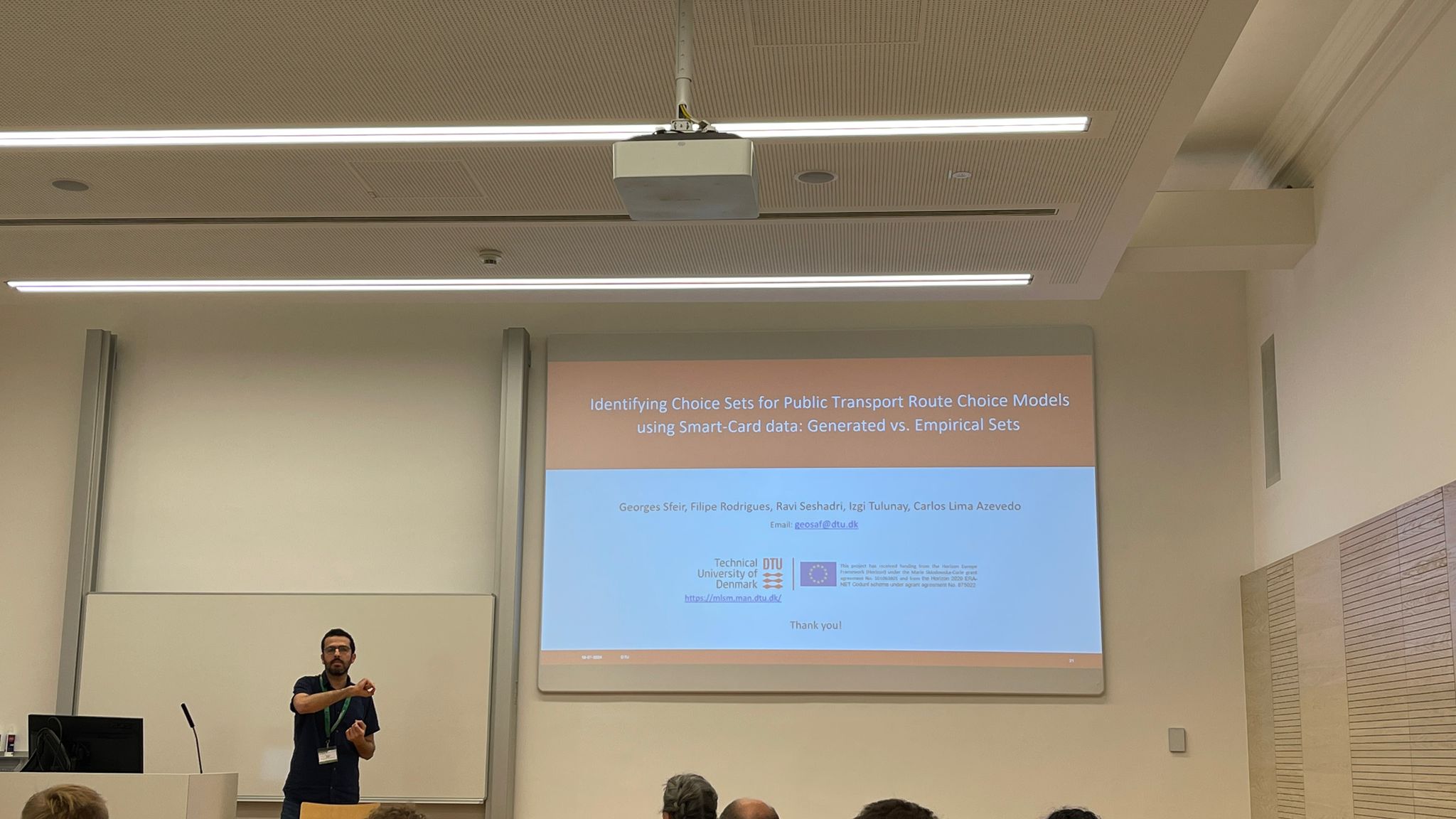
Next stop: Vienna! From July 14-18, 2024, I attended the 17th International Conference on Travel Behavior Research (IATBR), where I presented my latest research paper titled: “Identifying choice sets for public transport route choice models using smart-card data: generated vs. empirical sets”. This work was co-authored with Filipe Rodrigues, Ravi Seshadri, Izgi Tulunay, and Carlos Lima Azevedo.
This study investigates the effectiveness of using smart-card (SC) data to generate choice sets for multimodal public transport (PT) route choice models. Traditional models typically rely on generating possible routes (choice sets) through methods such as k-shortest paths, simulation, labelling, and other algorithms, which are then used to estimate passenger behavior and predict demand. However, these conventional approaches often fail to capture the actual routes passengers take, particularly in dense urban areas where the number of potential paths is vast.
To address this, we compare these conventional methods with an empirical approach that leverages data from the Rejsekort system, Denmark’s smart-card system for public transport. By analyzing tap-in and tap-out data from the Rejsekort, we generate choice sets that more accurately reflect real passenger behavior.
The study is conducted in the East Great Belt area of Denmark, a region with a complex PT network that includes buses, trains, and metro lines. The results show that while conventional methods cover a broad range of possible routes, they often generate many irrelevant alternatives that passengers do not actually consider. In contrast, the empirical approach using SC data produces fewer irrelevant options and is computationally more efficient, as it does not require the complex network-building processes inherent in conventional methods.
Moreover, the study finds that after collecting a few days’ worth of SC data, the empirical choice sets become comparable to those generated by traditional methods in terms of the number of alternatives per origin-destination pair, travel time variability, and path size distribution. However, the empirical approach shows an advantage in producing fewer routes with excessive transfers, which are less likely to be chosen by passengers.
In conclusion, the findings suggest that smart-card data can be a valuable resource for improving the precision and relevance of choice sets in PT route choice models. This approach not only better reflects actual passenger behavior but also offers a more efficient and potentially more accurate alternative to conventional choice set generation methods. The study proposes further refinement of the empirical approach by incorporating more SC data and applying it to stop-to-stop route choice models in future research.
You can check the slides from my presentation here!
Leave a Reply